

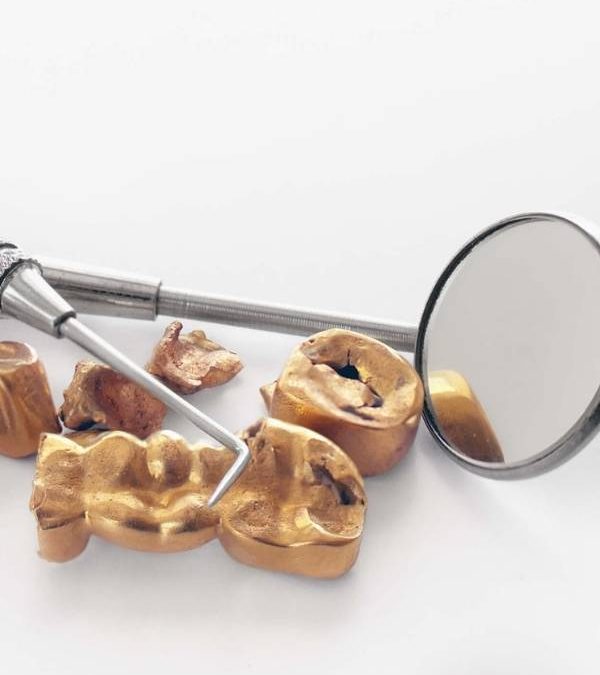
If you've ever held an old dental crown and wondered whether it's worth anything, you're not alone. Dentists, estate executors, oral surgeons, and everyday people come to us with the same question: how much gold is actually in a dental crown? The answer depends on several factors — the age of the crown, the alloy used, and whether it's a full cast crown or a porcelain-fused-to-metal (PFM) restoration. Understanding what you have is the first step toward getting paid fairly for it.
A Brief History of Gold in Dentistry
Gold has been used in dentistry for more than 2,000 years. Its durability, biocompatibility, and workability made it the material of choice for dental restorations long before modern ceramics existed. For much of the 20th century, gold crowns were considered the gold standard — literally — for back teeth restorations. It wasn't until the 1980s and 1990s that tooth-colored alternatives became widely adopted, and even today, gold remains a clinically preferred material for certain applications.
Older crowns — especially those placed before 1980 — are far more likely to contain high-gold alloys. More recently placed crowns may use lower-gold alloys or gold-colored base metal alternatives that contain little to no actual gold.
Types of Dental Gold Alloys
Not all dental gold is the same. Dental crowns are typically made from one of three general alloy categories:
High-Noble Alloys: These contain at least 60% noble metals (gold, platinum, palladium) and at least 40% gold by weight. Full cast gold crowns in this category are the most valuable and were commonly used in the mid-20th century. A single full-cast high-noble crown typically contains 2 to 3 grams of gold.
Noble Alloys: These contain at least 25% noble metals. Gold content varies widely — anywhere from 20% to 45% — with the remainder made up of silver, copper, palladium, and other metals. These are common in PFM crowns and represent moderate value.
Predominantly Base Metal Alloys: These contain less than 25% noble metals. Many have no gold at all. They may look gold-colored due to the presence of nickel or chromium. If you have these, they carry little to no precious metal value.
So How Much Gold Is in a Crown, Exactly?
A full cast gold crown — the solid yellow type most people picture — typically weighs between 2 and 4 grams total. If made from a high-noble alloy at 75% gold (roughly 18 karat equivalent), that's 1.5 to 3 grams of pure gold per crown. At current gold spot prices, a single full-cast crown can easily be worth $80 to $150 or more.
PFM crowns are a different story. The metal coping underneath the porcelain layer may weigh as little as 0.5 to 1 gram, and the gold content of that coping depends entirely on the alloy used. Some PFM crowns contain meaningful amounts of gold; others contain none at all.
The honest answer is: you can't know for certain without assaying the metal. Reputable dental gold refiners like Ark Refining use fire assay or X-ray fluorescence (XRF) testing to determine the exact precious metal content before making an offer. Be skeptical of any buyer who quotes you a price without testing your material first.
What Other Precious Metals May Be Present?
Gold rarely works alone in dental alloys. You'll frequently find platinum and palladium in the same crown. Palladium, in particular, has significant value and is commonly found in dental alloys from the 1980s and 1990s. A crown that appears to have modest gold content may still be quite valuable if it contains substantial palladium. A good refiner will account for all recoverable precious metals — not just gold — when calculating your payment.
How to Maximize the Value of Your Dental Gold
Whether you're a dental office with months of accumulated scrap or an individual with a handful of old crowns from a loved one's estate, a few principles apply universally. First, collect everything — bridges, inlays, onlays, partial denture frameworks, and crowns all have potential value. Second, don't clean or alter the metal before sending it for refining. Third, choose a refiner that provides full transparency: detailed assay reports, documented weights before and after processing, and payment based on actual precious metal recovery — not estimated value.
At Ark Refining, we work with dental practices, oral surgeons, and individuals across the country to provide accurate assays, competitive payouts, and straightforward service. If you're curious about what your dental scrap is worth, contact us today for a free consultation.